NICOLÁS CERVIO

An architect and designer for whom furniture is a natural extension of architecture, part of the same creative journey. He values multidisciplinarity and sees design as a process of constant exploration and learning.

When designing a piece of furniture, he imagines the context and everyday life of which it will become a part. For nobonobo, he created the Muro modular sofa – a sculptural, low-lined shape inspired by the aesthetics of the 1950s and 1970s, in which the characteristic 65° bevelled edge creates a sense of movement.

How did your journey into furniture design begin? Was there a moment that particularly influenced your decision to choose this path?

Although I'm technically an architect, I've always been drawn to designing objects, especially furniture. I believe that furniture, because of its close connection to the way we inhabit spaces, is a part of architecture. I see it as a natural extension of it.

For me, design, and furniture in particular, are part of the same creative journey. One of architecture's greatest strengths is that it allows us to transcend its own boundaries and think in a multidisciplinary manner. This broad perspective also requires continuous learning, a constant attitude of exploration, and the ability to discover new approaches to design.

muro_balmont_06 (4)

When designing furniture, do you imagine the space in which it will function, the specific type of interior, the atmosphere, the user?

When designing a piece of furniture, I envision the context in which it will function. This depends on the project's needs and the type of user it is intended for.

I like to think that a product will become part of people's daily lives and personal stories. Designing an item that will accompany these moments is incredibly important.

At the same time, it's often the user who ultimately defines the atmosphere of a product. Everyone interprets it and gives it their own unique character. I find this particularly interesting because it's the user who often reveals other ways of understanding it and integrating it into the space, thus enriching the design.

The Muro sofa designed for nobonobo has a very sculptural form, with echoes of 1950s and 1970s design. How did you translate these inspirations into contemporary design language?

References to the 1950s and 1970s became the starting point for creating a timeless and thoroughly contemporary piece. Today, it's no longer enough to simply address questions of functionality and comfort. Users have an increasingly clear sense of identity and are becoming increasingly demanding, seeking objects that also bring an emotional and intellectual dimension to everyday life.

„The 65° cut on the backrest and front of the armrest (...) of the Muro sofa (...) creates a sense of movement and inertia that defines the profile and gives the furniture a unique character.”

Was there a moment while working on Muro that particularly influenced the final character of the project?

Yes. The 65° angle cut on the backrest and front of the armrest was an important design decision in the creation of the Muro sofa. This element creates a sense of movement and inertia that defines the profile and gives the piece a unique character.

„I believe that furniture, because of its close connection with the way we inhabit spaces, is part of architecture. I see it as a natural extension of it.”

Muro is a modular system. How do you approach designing a piece of furniture that must simultaneously offer great freedom of configuration and maintain visual consistency?

When designing a modular system, I try to define a clear formal language that will remain consistent in every configuration.

What's particularly interesting about the Muro sofa is its adaptability to various scales and spatial requirements. This allows users to create arrangements that reflect their own preferences by combining modules. These compositional choices, always guided by nobonobo's professional guidance, define the final character of the piece without detracting from its distinctive expressive power.

GREG MCKINLEY

A designer from Wellington, New Zealand, whose path to design led through electrical engineering, architectural visualization, and self-developed 3D modeling skills. He creates forms most often directly in the digital space.

The nobonobo collection includes his designs: the Parfait armchair, which has won numerous awards in international competitions, the Peter bed, and the Split It modular sofa.

Your path to furniture design led you through electrical engineering, architectural visualization, and self-developed 3D modeling skills. How has this non-linear career path, far from traditional design schools, influenced your work?

Through my electrical engineering studies, I became familiar with 3D modeling software. My experience in modeling combined with architectural visualization gave me a unique perspective on starting the design process by creating prototypes using 3D software. Only some of my projects begin with hand-drawn sketches on paper. Architectural visualization gave me experience in combining shapes, materials, and colors in aesthetically pleasing ways.

parfait mood authors

The parfait was created directly in Marvelous Designer, which is evident in its quilting, almost confectionary, fluffy texture. How much of the final design was discovered in the tool, and how much was planned in advance?

My initial inspiration was an image of a simple, quilted piece of fabric I found online. It was this aesthetic I wanted to capture in the overall look of the quilt. I then moved to 3ds Max to create the main form of the chair. Marvelous Designer was essential for creating the feather quilting, helping me achieve the desired final result.

The Parfait armchair, the Peter bed, and the Split It modular sofa are three very different objects, yet they share a certain sensual exuberance of form. Is there a common, intuitive starting point that emerges in every project you design?

I'd say platforms like Pinterest and Google often inspire me to create new designs and images using artificial intelligence. I enjoy exploring sculptural forms, sometimes linear ones, two-dimensional drawings, materials, and upholstery details. This helps me gather ideas that I later incorporate into 3D design.

„Only some of my designs start with hand-drawn sketches on paper. Architectural visualization gave me experience in combining shapes, materials, and colors in an aesthetically pleasing way.”

Parfait received an Honorable Mention at the New York Design Awards. What do you think the jury saw in this chair? And does this interpretation align with what you had in mind when designing it?

I think the jury appreciated the unique aesthetic of the Parfait, the overall comfort, and the avant-garde character of this armchair. Perhaps they would like to encourage others with alternative educational paths to get involved in furniture design in the future? Anything is possible.

„I enjoy exploring sculptural forms, sometimes linear ones, two-dimensional drawings, materials, and upholstery details. This helps me gather ideas that I later use in 3D design.”

You design in Wellington, but the furniture is manufactured in Poland – a rather geographically distant collaboration. How does the distance from the factory, the European market, and the physical materials affect the work process?

I'm incredibly impressed with nobonobo's execution of my designs. Some elements are exactly as I imagined, while others have been refined from my original design. I'm always open to positive collaboration to create the best possible outcome for a piece of furniture. I have complete confidence in nobonobo's ability to bring my designs to life, regardless of the geographical distance between us.

EWA POLTORAK

Industrial designer, graduate of universities in Bydgoszcz, Poznań and Valencia. It was in Spain that she spent her first years of professional career and founded the Calma Creative studio, developing cooperation with the industry on many levels.

His approach always starts from observation, analysis and understanding of human needs. He designs furniture with a soft, calm form and architectural character, seeking a balance between expressive form and everyday comfort. For nobonobo she created the Lanube collection.

You studied industrial design in Bydgoszcz, furniture design in Poznań, and industrial design in Valencia, and it was in Spain that you spent several important years of your professional career. What did this design environment teach you about form, materials, and the way of looking at furniture?

Each of these environments introduced me to a different approach to design. However, it was my first professional experience at a design studio in Spain that truly opened my eyes to the responsibility of designing for industry, as well as the opportunities this profession offers. It was then that I felt the need to look at design more broadly than just through the prism of the product itself. The subsequent creation of the Calma Creative studio allowed me to develop this approach and collaborate with industry on many levels.

The form, material, and perception of a piece of furniture are often the essence of a design, but in practice, they're only part of a much more complex process. My first few years working in Spain taught me, above all, how fascinating, demanding, and unpredictable design is. Each project brings new questions and challenges. And that's precisely why I wouldn't trade this job for any other.

detal-lanube-pulsano-2@025x.png

You emphasize that design always begins with the human being, with observation, analysis, and understanding of needs. How does this moment of attentive listening to the user translate into specific formal decisions? Was there such a turning point in the Lanube project?

For Lanube, the turning point was finding a balance between expressive form and user comfort. From the outset, I aimed to create a soft, calm, architectural form, in which the backrest acts as a natural extension of the seat. At the same time, every formal decision had to be in harmony with ergonomics. Therefore, the additional cushions are not merely an aesthetic element; they are designed as an integral part of the support system, stemming directly from the sofa's architecture.

The Lanube sofa and bed – two distinct pieces of furniture, two zones of the home creating a coherent, calming formal language. What was the starting point for this project: the shape, the detail, the material, or perhaps the atmosphere of the space for which they were designed?

I must admit that from the outset of designing Lanube, I considered not so much the individual piece of furniture as the atmosphere it creates in a space. Both the sofa and the bed are designed for relaxation, so I aimed to create a calm, soft formal language that would naturally support everyday comfort.

It was from this idea that subsequent design decisions regarding form, proportion, and detail emerged. Distinctive, soft volumes, subtle quilting, and carefully crafted proportions were intended to create a sense of visual calm while simultaneously maintaining a distinctive, architectural character.

I wanted the furniture to be comfortable not only physically but also visually, to fit well into everyday life and create a space conducive to relaxation.

„In the case of the Lanube collection, the common point was relaxation – both the everyday, active kind associated with the life of the living room, and the more tranquil kind characteristic of the bedroom.”

Lanube is a collection that flows from the living room to the bedroom. How do you design furniture for such diverse uses—active presence and profound tranquility?

It's true that a sofa and a bed function in different areas of the home and address slightly different user needs. However, in the case of Lanube, the common thread was relaxation – both the everyday, active kind associated with the living room, and the more tranquil kind characteristic of the bedroom.

Once the sofa's proportions, ergonomics, and formal language were achieved, it was a natural step to transfer these values to the next product. The distinctive, soft volumes and stitching details became the building blocks of the entire collection's identity.

However, developing a product family doesn't always work this way. Sometimes, consciously introducing contrast between individual pieces of furniture offers greater value. With Lanube, however, from the outset, we aimed to create a cohesive world in which both the sofa and the bed tell the same story of comfort, softness, and tranquility.

„I increasingly think of design as a search for a balance between innovation and timelessness. I believe that a designer's role is not to create objects that will attract attention only for a moment, but ones that will have the potential to function for many years.”

You've often said that good furniture should last for years and have a second life. How does this long-term perspective influence the decisions you make during the design process?

I increasingly think of design as a search for a balance between innovation and timelessness. I believe that a designer's role isn't to create objects that will attract attention only for a moment, but ones that will have the potential to function for many years.

If a design becomes too expressive, too sculptural, or strays too far from the realities of an industrial product, it risks becoming outdated more quickly.

Of course, there are exceptions and many iconic designs defy this rule, but for me it is becoming increasingly important to find the right balance between my own vision and the needs of the industry and the user.

This is where solutions that are likely to stand the test of time are most often born.

NELSON DE ARAÚJO

Portuguese designer, for whom the breakthrough came during his almost year-long stay in Italy during his studies and direct contact with the design culture deeply rooted in everyday life. He grew up in a quiet seaside town, in the rhythm of slow living, and it is this closeness to nature that shapes his personality to this day. the search for minimalism and balance.

For nobonobo, he designed the Margo sofa and armchair, as well as the Roots table, in which the combination of metal and wood reflects his pursuit of material honesty.

Your path to furniture design began in Portugal, but a stay in Italy during your studies was also a significant moment. How did these experiences shape your way of thinking about design?

Each of these environments introduced me to a different approach to design. However, it was my first professional experience at a design studio in Spain that truly opened my eyes to the responsibility of designing for industry, as well as the opportunities this profession offers. It was then that I felt the need to look at design more broadly than just through the prism of the product itself. The subsequent creation of the Calma Creative studio allowed me to develop this approach and collaborate with industry on many levels.

The form, material, and perception of a piece of furniture are often the essence of a design, but in practice, they're only part of a much more complex process. My first few years working in Spain taught me, above all, how fascinating, demanding, and unpredictable design is. Each project brings new questions and challenges. And that's precisely why I wouldn't trade this job for any other.

Nelson de Araujo Roots 02

You often speak of minimalism and balance in your designs. Where do you most often draw inspiration from? Is it observations of nature, architecture, travel, or perhaps the everyday experiences of users?

I believe my greatest inspiration comes from my roots. I grew up in a very quiet city with a slow-paced lifestyle, always close to the sea, rivers, and mountains. Although I no longer live there, this connection with nature remains with me and strongly influences my creativity and my search for minimalism and balance.

On the other hand, traveling is fundamental to me. Experiencing different cultures and customs leads me to question how we live and interact with objects on a daily basis. It is from this blend of nature and contact with new realities that the desire to test materials, create new shapes, and challenge the boundaries of my work is born.

You designed several different pieces of furniture for nobonobo—the Margo sofa and armchair, and the Roots table. Did you envision them as elements of a shared design language from the outset?

Funnily enough, no. Both the Margo line and the Roots table originated from loose sketches, ideas that emerged as I explored shapes, colors, and materials. Initially, they weren't designed as a „family” or to share the same space. However, because they were created around the same time, they developed a similar language and coexist perfectly. Furthermore, I always strive to maintain a clear identity in what I do. I believe it's precisely because of this constant connection that my works ultimately speak the same language and fit together so naturally.

„The Roots table was created while I was exploring the combination of metal and wood. These two materials come from nature, but although they go through industrial processes before taking on their final form, their natural origins are still present.”

The form of the Roots table clearly evokes the organic shapes of nature. What was the process of translating this inspiration into a specific structure and material?

The Roots table was created while I was exploring the combination of metal and wood. These two materials come from nature, and although they go through industrial processes before they take their final form, their natural origins are still present. For me, furniture design must be as honest as possible. My creative process largely revolved around this: I tried to limit the use of artificial materials and let the structure, weight of the metal, and the texture of the wood speak for themselves. This way, I could bring this organic inspiration to the design—honestly and without pretense.

„My approach is to always start with this ergonomic base—it's the skeleton of the design. Only then do I slowly begin to adapt the form and work on the design. This way, I ensure the design is not only visually appealing but also genuinely comfortable and inviting.”

In designs like the Margo sofa and armchair, the balance between expressive form and comfort is crucial. How do you achieve that point where a design becomes both aesthetically pleasing and truly comfortable?

It all starts with a fundamental principle: ergonomics, always adapted to the market we're designing for. Proven ergonomic solutions already exist, and we know they work and guarantee comfort. The real challenge is finding the perfect balance between aesthetics and functionality.

My approach is to always start with this ergonomic base—the skeleton of the design. Only then do I slowly begin to adapt the form and work on the design. This way, I ensure that the design is not only visually appealing but also genuinely comfortable and inviting.

RUYA AKYOL

Designer from Istanbul, graduate of Istanbul Technical University, Politecnico di Milano and Domus Academy. She gained experience working with Claudio Bellini in Milan and Philippe Starck in Paris. Her style is a synthesis of Italian design culture, Scandinavian minimalism and Anatolian heritage. He runs his own studio, also dealing with brand identity and art direction.

The nobonobo collection includes her Bacione armchair with a soft, enveloping shape, whose name means „big kiss” in Italian.

You grew up in Istanbul, studied at the Politecnico di Milano and the Domus Academy, and worked with Claudio Bellini in Milan and Philippe Starck in Paris. These are two completely different design temperaments: Italian precision and rigor on the one hand, provocation and theatricality on the other. What did you gain from each of these experiences?

This gave me the opportunity to look at design from three different perspectives. At the Istanbul Polytechnic and the Milan Polytechnic, I gained a solid education in production, design principles, and the fundamentals of the field. Domus Academy, on the other hand, gave me a broader understanding of the marketing and visual aspects of design through projects I carried out in collaboration with designers and companies in the industry.

I began working with Claudio Bellini very early in my career and gradually developed within that studio, which shaped my working method while allowing my creative side to flourish. Finally, while working with Philippe Starck, I had the opportunity to observe the highly original and personal way he approaches projects and clients. This experience inspired me to forge my own path.

detal bacione

Your style has been described as a synthesis of contemporary Italian design culture and Scandinavian minimalism, yet you are also a designer shaped by Istanbul and your Anatolian heritage. How do these three perspectives—Middle Eastern, Mediterranean, and Nordic—interact in your daily work?

Combining these different cultures and practices with my own perspective helped me develop a personal design language. Coming from a diverse culture, after many years living in Italy, I learned to design objects with proper proportions and attention to detail. I've always been passionate about Scandinavian design, and marrying a Swedish architect allowed me to deeply understand minimalism and experience it firsthand in Stockholm.

I usually start my designs from a very conceptual perspective, then give objects their appropriate dimensions and proportions. Finally, I examine the design to understand what can be removed or added to achieve the most relevant version of the idea.

Bacione means „big kiss” in Italian, and this name is also a precise description of the form: soft shapes, curves, and enveloping proportions. What was the starting point? Did the word come first, or the form?

The idea of designing an iconic, rounded, and cozy armchair came to me from the very beginning. Later, I realized that giving someone a kiss upon returning home seemed like the most sincere gesture of welcome.

I asked myself why not design an armchair that gives a kiss, especially in times when everything is becoming less and less authentic and personal?

„(…) The thought occurred to me that giving someone a kiss upon returning home seemed like the most sincere gesture of welcome. I asked myself, why not design an armchair that gives a kiss, especially in a time when everything is becoming less and less authentic and personal?”

In the Bacione armchair, warmth and sensuality are achieved without any literal gestures. There are no ornaments or decorative details. How do you work to ensure that an abstract form conveys such a concrete, almost physical feeling?

For me, form is never just a matter of geometry. It's also about emotion, gesture, and memory. With Bacione, I wanted the shape to feel instinctive, almost familiar, like something you immediately want to approach and touch.

I usually start with a general idea and then work through many variations and iterations until the piece embodies that idea with minimal effort. In this case, the softness, rounded shapes, and enveloping proportions stem from precisely that intention: to create a piece that feels warm, generous, and discreetly intimate, without the need for additional decoration.

„For me, form is never just a matter of geometry. It's also about emotion, gesture, and memory. In Bacione's case, softness, rounded shapes, and enveloping proportions stem from the intention to create a work that feels warm, generous, and discreetly intimate, without the need for additional decoration.”

In addition to design, you work with brand identity and art direction. Does this dual perspective, as a creator of objects and an architect of visual communication, influence the way you think about the furniture you design?

I believe that all design disciplines are closely interconnected. During my studies, I tried to take as many communication design classes as possible to strengthen my visual perspective.

As the founder of a design studio that also offers art direction services, I work on projects spanning material libraries and visual communication tools, as well as interior and product design. This approach allows me to understand what each discipline needs from the others and hone my skills not only from the perspective of individual design disciplines but also through a more holistic and comprehensive approach.

TOMEK RYGALIK

One of the most recognizable Polish designers, artistic director of nobonobo from 2019 to 2022. In his practice, he combines formal discipline with material experimentation and often speaks about the moral dimension of design – creating things that deserve to exist.

For nobonobo he created an extensive family of Wadi furniture (sofa, armchair and pouffe), as well as the Raksa sofa, the Tupak armchair, the Nato table set and the Oo table.

From 2019 to 2022, you served as nobonobo's artistic director, a role fundamentally different from commissioned design. How did this dual role of simultaneously creating and curating the brand's identity influence the way you thought about each new project?

Creating the brand from scratch, including its name, logo, and strategic foundations, served as the starting point for further work, such as designing products that would constitute the new identity. These products were to express a completely new approach to offerings, based on the originality of the original design, which already boasted a high level of craftsmanship.

To define this direction and establish a coherent aesthetic—a foundation for further development—several interconnected furniture types were needed, each addressing different market needs: from a sales hit, through an image icon, to complementary armchairs and tables. While this may sound simple today, it was a significant challenge and a huge amount of work, especially considering the varying levels of design awareness and market attitudes at the time.

Wadi_Vamos07_detal_3547

Wadi is the most extensive furniture family you've created for nobonobo, encompassing a sofa, armchair, and pouffe. What's the idea behind this collection?

Almost every product family I design incorporates a modular system, allowing for the creation of various configurations and types. Most sofas available on the market are based on a similar typology and construction principle, so in this collection I deliberately utilized a much less common configuration method, based on repeating modules in the form of „slices.” Their number defines the width of the seat, and on either side are similar modules with armrests.

The main idea was to create a model that could be disassembled into its basic components – not only for washing the fabric, but above all for the possibility of repairing or disposing of individual materials, in the spirit of sustainable development.

Your designs are based, among other things, on a dialogue between formal discipline and material experimentation. How do these principles work in the case of upholstered furniture, whose form is largely defined by softness and the concealment of structure?

I also design upholstered products from the inside out, ensuring they are carefully considered in every respect. Good function and form are the result of this approach.

„Most sofas available on the market are based on a similar typology and construction principle, so in the Wadi collection I deliberately used a much less common configuration method, based on repeating modules in the form of „slices.” Their number defines the width of the seat, with corresponding modules with armrests on either side.”

You often speak about the moral dimension of design, about creating things that deserve to exist. How does this ethics operate within the everyday reality of a furniture brand?

This is a significant and complex dilemma stemming from the consumerist paradigm. We all participate in shaping the world around us every day – from experiences and emotions, through workplaces, to the modernization and development of the country, as well as waste generation and environmental impact.

It is good to actively support positive changes at every step, thus developing awareness of yourself and your surroundings.

„We all participate in shaping the world around us every day – from experiences and emotions, through jobs, to the modernization and development of the country, as well as the generation of waste and the impact on the natural environment.

It is good to actively support positive changes at every step, thus developing awareness of yourself and your surroundings.”

Looking at the entire collection you created for nobonobo – from the Wadi furniture, through the Raksa sofa and Tupak armchair, to the Nato coffee table set and the Oo table – is there a formal or philosophical thread that connects these designs into a coherent story?

This is a coherent story, formally, materially, technologically, and ethically, constituting a new, credible brand. It provides a foundation and unlimited potential for further development, not only in the material sphere.

THOMAS
MATEJCZYK

Co-founder of the nobonobo brand, which he founded together with Monika Struska. His path to design led through quality and craftsmanship; his previous experience in the automotive industry taught him an appreciation for design, materials and precision. Today, he combines the role of designer with responsibility for the development of the collection, also through collaboration with other creators. His designs are closely linked to the perspective of a craftsman and his pursuit of simplifying form and working with pure geometry.

The furniture he designed in the nobonobo collection includes the Classic and Feza sofas and the Siga 80 armchair, which combines a massive shape with the softness of the material and a clear reference to the aesthetics of the 1980s.

Nobonobo was created as a joint brand by you and Monika Struska. Initially, you weren't a designer. At what point did you start designing products in parallel, and how did that influence the brand's development?

My path to design led through quality and craftsmanship. My previous experience in the automotive industry taught me to pay attention to design, materials, and precision, including those elements of the product that the customer doesn't see but whose quality is felt during use. Over time, I became increasingly involved in shaping the furniture itself: its proportions, detail, comfort, and character. 

Alongside my responsibility for brand development, I also felt the need to give specific products their own unique form, and these two roles began to intertwine. To this day, the craftsman's perspective remains very close to my heart – an idea must be effective in terms of material, construction, and everyday use, especially in the case of a sofa, which is experienced both visually and with the whole body.

bibia dąb naturalny detal pion

Today, you combine the roles of designer and collection development co-creator through collaboration with other creators. How does this dual perspective impact how you define brand cohesion?

I look at each piece of furniture both as a standalone project and as part of a larger whole. As a designer, I focus on proportion, detail, and comfort; as a co-creator of nobonobo, I evaluate what a given piece brings to the collection and the direction it takes the brand forward.

I define cohesion primarily through consistency in decision-making. My benchmarks are expressive form, thoughtful comfort, and craftsmanship. This provides us with a common foundation while also allowing room for diverse creative personalities. It also requires a sense of distance from my own creation: I evaluate my own designs according to the same criteria as others. It is precisely in these choices that brand cohesion is born – in the conscious building of relationships between products that possess their own personalities, yet together create a recognizable collection.

Designs like Classic demonstrate a commitment to simplified form. What's your process like working with geometry, where's the fine line between simplicity and loss of character?

When working with geometry, the most important thing for me is the relationship between the individual parts of a piece of furniture: the width of the armrest relative to the seat, the height of the backrest, the proportions of the base and the overall shape. These relationships determine whether a sofa appears light, substantial, calm, or expressive. With a minimalist form, even a small change can significantly impact the character of the piece.

For me, the Classic is all about the balance between clear geometry and softness. The simple shape organizes the silhouette, while the cushions and upholstery lend it a relaxed, welcoming feel. The limits of simplification appear when yet another change begins to weaken what makes the piece recognizable. A well-simplified form possesses a certain obviousness: the individual parts fit together in a way that makes it difficult to imagine any other solution.

„The connection to the 1980s has a personal meaning for me, connected to childhood memories. The boldness, exuberance of form, and distinct personality of objects from that aesthetic are close to my heart. This project demonstrates the direction I want to develop at nobonobo: greater freedom in scale, more sculptural forms, and a bolder use of materials.”

Collections like Feza demonstrate the concept of furniture as an arrangement of solids functioning in relationship. When designing, do you think more about a single object or about a structure that organizes space?

I think primarily about the furniture as a whole, whose character stems from the relationships between its elements. In a sofa, the seat, backrest, armrests, and base must work together. I'm interested in how several shapes create one expressive, well-thought-out object. Modularity is also crucial for Feza: when designing such a piece, you have to consider both the individual element and its possible connections with others. Joints, line continuity, and how the sofa's proportions change as it expands become crucial. I want Feza to retain its character in both compact and more expansive versions, with each element finding its justification and creating a compelling whole with the others.

The latest Siga 80 armchair features a tension between the massive, blocky form and the softness of the material, with a clear reference to the aesthetic of the 1980s. How did you work on this balance, and what does this design say about the future development of the brand's language?

I wanted the solidity of the shape and the softness to reinforce each other. The blocky elements give the armchair a decisive silhouette, while the upholstery makes this same form pleasant to the touch. I sought balance primarily in the proportions of the seat, backrest, and armrests. In such a piece, even the slightest change in curve or fabric tension can determine whether the shape feels stiff or inviting.

The connection to the 1980s also has a personal meaning for me, connected to childhood memories. The boldness, exuberance of form, and distinct personality of objects from that aesthetic are close to my heart. This project demonstrates the direction I want to develop at nobonobo: greater freedom in scale, more sculptural forms, and a bolder use of materials. Simplicity is still important to me, but I'm increasingly interested in how much expression can be achieved with a few decisive elements.

„I look at each piece of furniture as both a standalone project and part of a larger whole. As a designer, I focus on proportions, detail, and comfort; as a co-creator of nobonobo, I evaluate what a given piece brings to the collection and the direction in which it develops the brand.”

When designing and developing a brand, you balance intuition with strategic decisions. What matters more to you today: consistency in design language, user needs, or the brand's business development?

I don't consider these three elements to be competing. For me, a good brand is created when form, user needs, and business development support each other. If one of these areas begins to dominate at the expense of the others, the product loses its balance. However, the starting point is always the furniture itself: it must have a compelling form, be comfortable, and meet the user's real needs. It's also important how it ages and how the user perceives it after several years, not just at the time of its release.

I don't understand consistency in brand language as repeating the same solutions, but as a way of thinking about proportion, comfort, build quality, and expressiveness. I view business development as a consequence of a good product, not the other way around.

DAVID GIRELLI

A designer whose professional background combines engineering, fashion and interior design, three disciplines with different understandings of the relationship between product and user. His philosophy is based on the pursuit of timeless elegance and the elimination of unnecessary detail.

For nobonobo, he designed the Fulu armchair, whose organic shape was born from the image of beach pebbles, smooth, irregular forms shaped by water.

CHRIS STANFEL

A Spanish product designer from Valencia who likes to use unusual, botanical references in his work, blurring the boundaries between furniture categories.

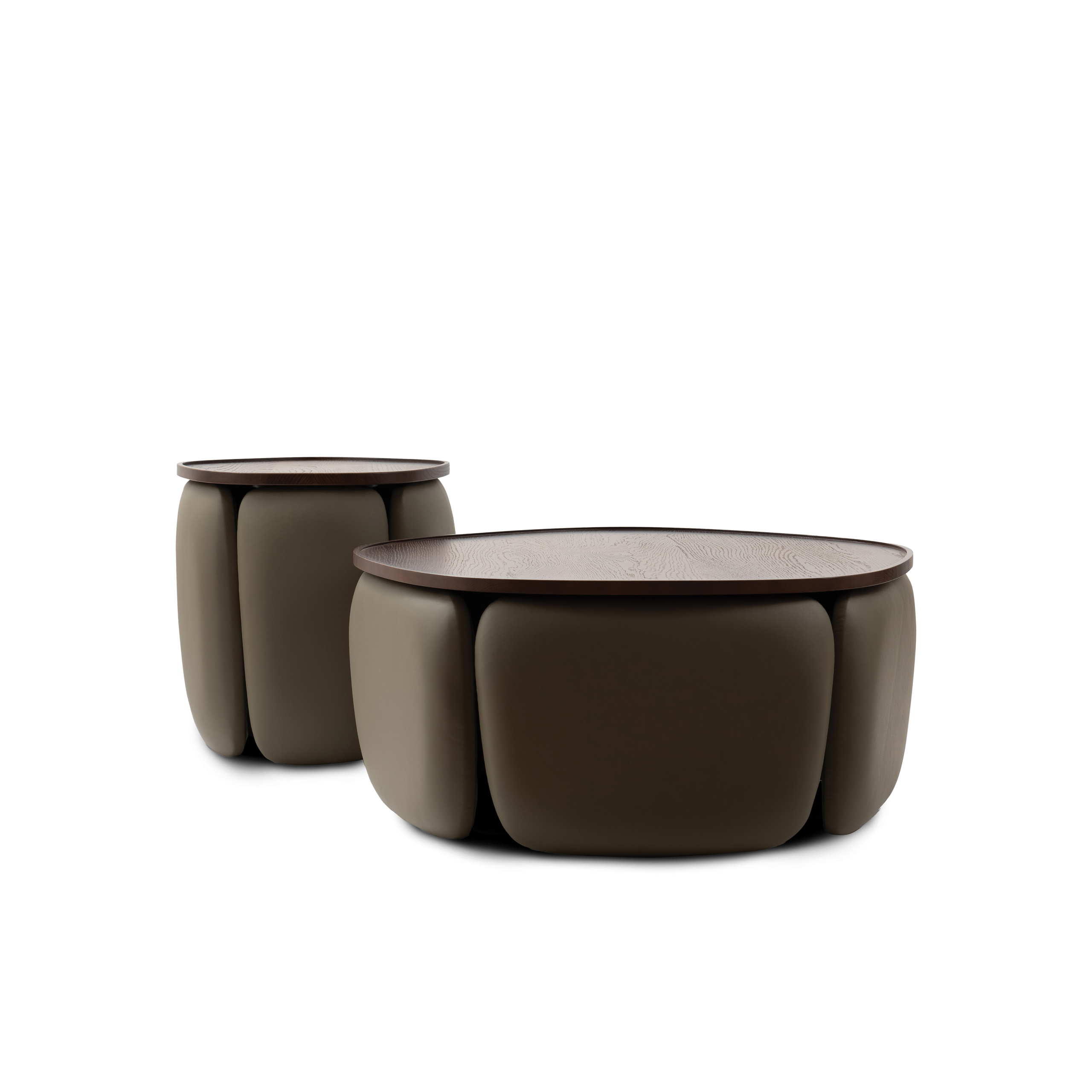
For nobonobo, he designed a set of Flesia tables, inspired by the rafflesia, an exotic flower from the forests of Indonesia. The table's upholstered legs, reminiscent of the plant's petals, deliberately break the stereotype of a coffee table.

JUANNA BARCELÒ BORGES

A designer whose path led him through Milan and collaborations with renowned studios, including Claudio Bellini Design Group and Roberto Semprini Studio. From these experiences, he gained two complementary perspectives: attention to form and the cultural dimension of design and a pragmatic understanding of furniture as an industrial product.

In his work, he emphasizes that the design should support the user, the product strategy, and the brand. For nobonobo he designed the MAXXO sofa, with a strong shape and characteristic armrests.

Your design journey took you through Milan and collaborations with renowned design studios like Claudio Bellini Design Group and Roberto Semprini Studio. How have these experiences influenced the way you think about furniture design today?

Working in Milan was fundamental to how I think about furniture today, as it gave me two complementary perspectives. On the one hand, a strong focus on form, proportion, and the cultural dimension of design, the idea that a piece of furniture should have a clear identity and an emotional presence in space. On the other, a pragmatic understanding of furniture as an industrial product: something that must be designed, manufactured, and positioned in the market.

At Claudio Bellini Design Group, I learned a structured, international approach in which aesthetics, brand language, production constraints, and commercial objectives had to coexist. Roberto Semprini Studio, on the other hand, emphasizes the value of expressive form, atmosphere, and narrative. Together, they taught me to view furniture not as isolated objects but as part of a broader system encompassing users, production, brand identity, and strategy, a principle that still guides my work today.

maxxo detal armagnac@0,5x

In your work, you emphasize that design should support not only the user but also product strategy and brand development. How does this philosophy influence the way you approach new projects?

For me, design begins with the user, but it should never end there. A good product must meet the practical and emotional needs of the person who lives with it, but it must also make sense within the broader brand strategy.

When I begin a project, I try to understand several layers at once: who the product is for, how it will be used, what space it belongs in, and what role it should play in the company's catalog. Sometimes the product needs to be commercial and accessible, sometimes it needs to be a distinctive element that adds personality to the entire product range. This helps me make informed decisions about proportions, materials, details, and cost. My goal isn't simply to create a pretty item, but one that is cohesive, useful, desirable, and strategically relevant to the brand.

Your designs often combine sculptural form with a keen attention to detail and proportion. Where do you most often draw inspiration from? Is it materials, architecture, technology, or perhaps observing how people use furniture?

Inspiration usually comes from the combination of different elements, rather than from a single source. Architecture is important to me, as is the way volumes, lines, and proportions create presence and rhythm in a space. I'm interested in how a single detail or silhouette can define an object.

At the same time, observing how people actually live with furniture is essential. Furniture is always close to the body and daily rituals, so comfort and movement influence design. Materials are equally important, as they can imbue a form with a warmer, softer, lighter, or more architectural character. In a sense, inspiration is the meeting point of these worlds: architecture for structure and proportion, materials for character and touch, and real life for comfort.

„The starting point for MAXXO was a sofa that appeared minimalist in its overall styling, but at the same time had a strong sculptural identity: visually calm and architectural, yet instantly recognizable thanks to a few carefully crafted details.”

The MAXXO sofa stands out for its strong, architectural shape and distinctive armrests. What was the main idea behind this design, and how did it develop during the design process?

The starting point for MAXXO was a sofa that appeared minimalist in its overall styling, but at the same time had a strong sculptural identity, visually calm and architectural, yet instantly recognizable thanks to a few carefully crafted details.

The focal point was the large armrests, which protrude slightly outward, giving the impression of being suspended above the main body. They add character to the sofa, but they aren't just decorative: their slight inclination also contributes to comfort. Another key element was the stitched contour that runs along the silhouette. I like to use stitching almost as a graphic tool to emphasize the profile and give the form a more tailored feel.

With a design like MAXXO, everything depends on balance: if the armrests become too heavy, the sofa loses its elegance; if the details are too subtle, the identity disappears. The design's evolution was really about refining the proportions until sculptural expression and comfort could coexist.

„Inspiration usually comes from the combination of various elements, rather than from a single source. Architecture is important to me, as is the way volumes, lines, and proportions create presence and rhythm in a space. I'm interested in how a single detail or silhouette can define an object.„`

When designing sofas, the balance between expressive form and comfort is key. How did you combine these two aspects in this project?

For me, comfort must be part of the design logic from the very beginning. With MAXXO, the intention was to create a sofa with a distinctive, architectural presence, without feeling stiff or intimidating.

This balance was achieved primarily through proportions and detailing. The shape is bold and clearly defined, but softened by the way the armrests protrude outward and are slightly angled, creating a more welcoming position. The generous cushions and visual softness of the upholstery balance the geometry of the frame.

The most interesting furniture often operates in this tension between precision and softness. I wanted the MAXXO to stand out from a distance, yet convey a sense of security and comfort the moment you sit on it.

STUDIO CarlesiTonelli

Italian design studio founded in 2004 by Davide Carlesi and Gian Luca Tonelli, who combined their experiences and different paths in industrial design. Their approach is characterized by the rigor of drawing, essential style, technical research and a sense of humor.

The studio focuses on industrial design, carefully examining production processes, new materials, and technologies. The nobonobo collection includes chairs designed by them—an area where Italian design culture most strongly shapes the form and character of furniture.

AGATA BUGALSKA

A Master of Arts graduate in design from the Władysław Strzemiński Academy of Fine Arts in Łódź, she designs in 2D and 3D, combining client research, technological awareness, and artistic thinking – composition and form creation. For her, the most important thing in design is awareness: of herself, the recipient and the object being created.

For nobonobo, she designed the Abala bed, whose openness, calmness and minimalist lines draw inspiration from the African landscapes present both in the form of the furniture and in its name.

KONONENKO ID STUDIO

Founded in 2012 by Julia Kononenko and Artem Kravchenko, the Ukrainian studio's motto is „the art of transforming ideas into form.” Its foundation is the meeting of two temperaments: Julia's artistic, sculptural sensibility and Artem's technical, engineering thinking.

The studio's design language defies easy categorization, combining Bauhaus rationalism, Scandinavian simplicity, and Ukrainian craftsmanship. For nobonobo, the studio designed the Manduria bed, an object thought out formally and functionally.

SERGEY MURKO

Ukrainian designer from Kiev, founder of the MURI brand, for whom creating furniture is an art. He graduated in law and economics, but design has always been closest to him.

For nobonobo, he designed the Bunny Guys armchair, featuring a recognizable rabbit-inspired silhouette. Its distinctive shaggy and flossy fur dramatically transforms the piece's ambiance. The armchair is equally at home in living rooms, children's rooms, and public spaces.

STAS LITVINOV

A designer for whom simplicity is a conscious choice, a supporter of honest design. He believes that a product must earn its right to exist, and that refusing to follow trends gives it the chance to become a timeless classic.

The nobonobo collection includes his Uni armchair – an icon of private and commercial interiors, in which well-thought-out, recyclable materials combine with a universal, versatile form.

You studied industrial design in Bydgoszcz, furniture design in Poznań, and industrial design in Valencia, and it was in Spain that you spent several important years of your professional career. What did this design environment teach you about form, materials, and the way of looking at furniture?

Each of these environments introduced me to a different approach to design. However, it was my first professional experience at a design studio in Spain that truly opened my eyes to the responsibility of designing for industry, as well as the opportunities this profession offers. It was then that I felt the need to look at design more broadly than just through the prism of the product itself. The subsequent creation of the Calma Creative studio allowed me to develop this approach and collaborate with industry on many levels.

The form, material, and perception of a piece of furniture are often the essence of a design, but in practice, they're only part of a much more complex process. My first few years working in Spain taught me, above all, how fascinating, demanding, and unpredictable design is. Each project brings new questions and challenges. And that's precisely why I wouldn't trade this job for any other.

detal-lanube-pulsano-2@025x.png

You emphasize that design always begins with the human being, with observation, analysis, and understanding of needs. How does this moment of attentive listening to the user translate into specific formal decisions? Was there such a turning point in the Lanube project?

For Lanube, the turning point was finding a balance between expressive form and user comfort. From the outset, I aimed to create a soft, calm, architectural form, in which the backrest acts as a natural extension of the seat. At the same time, every formal decision had to be in harmony with ergonomics. Therefore, the additional cushions are not merely an aesthetic element; they are designed as an integral part of the support system, stemming directly from the sofa's architecture.

The Lanube sofa and bed – two distinct pieces of furniture, two zones of the home creating a coherent, calming formal language. What was the starting point for this project: the shape, the detail, the material, or perhaps the atmosphere of the space for which they were designed?

I must admit that from the outset of designing Lanube, I considered not so much the individual piece of furniture as the atmosphere it creates in a space. Both the sofa and the bed are designed for relaxation, so I aimed to create a calm, soft formal language that would naturally support everyday comfort.

It was from this idea that subsequent design decisions regarding form, proportion, and detail emerged. Distinctive, soft volumes, subtle quilting, and carefully crafted proportions were intended to create a sense of visual calm while simultaneously maintaining a distinctive, architectural character.

I wanted the furniture to be comfortable not only physically but also visually, to fit well into everyday life and create a space conducive to relaxation.

„In the case of the Lanube collection, the common point was relaxation – both the everyday, active kind associated with the life of the living room, and the more tranquil kind characteristic of the bedroom.”

Lanube is a collection that flows from the living room to the bedroom. How do you design furniture for such diverse uses—active presence and profound tranquility?

It's true that a sofa and a bed function in different areas of the home and address slightly different user needs. However, in the case of Lanube, the common thread was relaxation – both the everyday, active kind associated with the living room, and the more tranquil kind characteristic of the bedroom.

Once the sofa's proportions, ergonomics, and formal language were achieved, it was a natural step to transfer these values to the next product. The distinctive, soft volumes and stitching details became the building blocks of the entire collection's identity.

However, developing a product family doesn't always work this way. Sometimes, consciously introducing contrast between individual pieces of furniture offers greater value. With Lanube, however, from the outset, we aimed to create a cohesive world in which both the sofa and the bed tell the same story of comfort, softness, and tranquility.

„I increasingly think of design as a search for a balance between innovation and timelessness. I believe that a designer's role is not to create objects that will attract attention only for a moment, but ones that will have the potential to function for many years.”

You've often said that good furniture should last for years and have a second life. How does this long-term perspective influence the decisions you make during the design process?

I increasingly think of design as a search for a balance between innovation and timelessness. I believe that a designer's role isn't to create objects that will attract attention only for a moment, but ones that will have the potential to function for many years.

If a design becomes too expressive, too sculptural, or strays too far from the realities of an industrial product, it risks becoming outdated more quickly.

Of course, there are exceptions and many iconic designs defy this rule, but for me it is becoming increasingly important to find the right balance between my own vision and the needs of the industry and the user.

This is where solutions that are likely to stand the test of time are most often born.

LEVANTIN STUDIO

Founded in 2012 in Kharkiv and currently operating from Milan, the studio began with experiments in furniture restoration during his studies. The passion for giving objects a second life still shapes the philosophy of Levantin Studio in the context of conscious creation.

For nobonobo, the studio designed the Kohti stool with a seat made of recycled HDPE, which won a Silver Award at the International Design Awards, and a chair from the same family. The design philosophy remains unchanged: honest materials and solid construction.

Levantin Design began, as you describe, with experiments in furniture restoration during your studies. How did this act of transformation, of giving new life to existing objects, shape the philosophy that underpins your work today?

Our renovation work shaped our most important design principle: conscious creation. Our goal is not simply to create new objects, but to enrich the world with objects of true value, of which we can be truly proud, each and every one.

Levantin_Studio_16

The Kohti stool grew out of a deeply considered approach to material. Its seat is made from recycled HDPE – shampoo bottle caps processed by the Precious Plastic Ukraine workshop. How did this material become the starting point for the design, rather than just a specification added after the fact?

We often begin a project with a curiosity about a material or technology. In the case of Kohti, recycled plastic was the starting point. By the time the project began, we already had manufacturing experience, allowing us to create a structure that appeared simple, yet required exceptional precision: complex bend radii, precisely formed metal, and refined connections. Therefore, we consciously made the seat the main visual accent.

Over time, the collection expanded to include an upholstered version, addressing new needs related to comfort and use. However, the design philosophy remained unchanged: honest materials and solid construction.

The name Kohti—a Finnish word meaning „toward”—conveys the idea of movement in two directions simultaneously: toward the environment, and toward a product that embraces change rather than resists it. How do you build such conceptual depth into an object without turning it into a statement?

We enjoy symbolism, but we never create it artificially. With an open perspective on the world, ideas emerge naturally. Many experiences stay with us and, over time, become the impetus for a design. We want the concept not to completely explain the object, but merely to imbue it with an additional layer of meaning, leaving everyone room for their own interpretation.

„For Kohti, recycled plastic was the starting point. Our manufacturing experience allowed us to create a structure that required exceptional precision: complex bend radii, precisely formed metal, and refined connections. We consciously made the seat the main visual accent.”

Kohti won the Silver Award in the Eco-Sustainable Design category at the International Design Awards. However, ecological design can sometimes be perceived as limiting. In your experience, does working within the constraints imposed by materials and the environment open up new formal possibilities, or does it primarily require a different approach to problem-solving?

Constraints act as a powerful creative discipline. At first, they may seem to limit the scope of your work, but it's within this framework that ideas cease to be abstract. When a design is based on a clearly defined brief and material specifications, the final product becomes more compelling.

„Constraints act as a good creative discipline. At first, they may seem to limit the scope of maneuver, but it is within this framework that ideas cease to be abstract. When a design is based on a clearly defined brief and material specifications, the final product becomes more compelling.”

Your studio was born in Kharkiv and then moved to Milan. How did this journey, from Ukraine to the heart of European design, shape your workflow, and what did it mean for you to relocate your design practice to another country?

We founded our studio in Kharkiv in 2012, but from the very beginning, we aimed for an international audience. We soon found a representative in Poland and presented our designs at the Warsaw Home trade fair. Later, at the invitation of an Italian company, we moved to Italy, where we could test our skills in one of the world's most important furniture industries.

We admire the Italian school of design for its ability to cultivate craftsmanship and tradition, while simultaneously daring to continually set new trends. Our cross-cultural experience allows us not only to draw inspiration from this environment but also to view it from a certain perspective. It is at the intersection of these two perspectives that new interpretations and subtle, creative challenges to established patterns emerge.

SEARCH ENGINE

Discover nobonobo

Find your model, collection or inspiration.