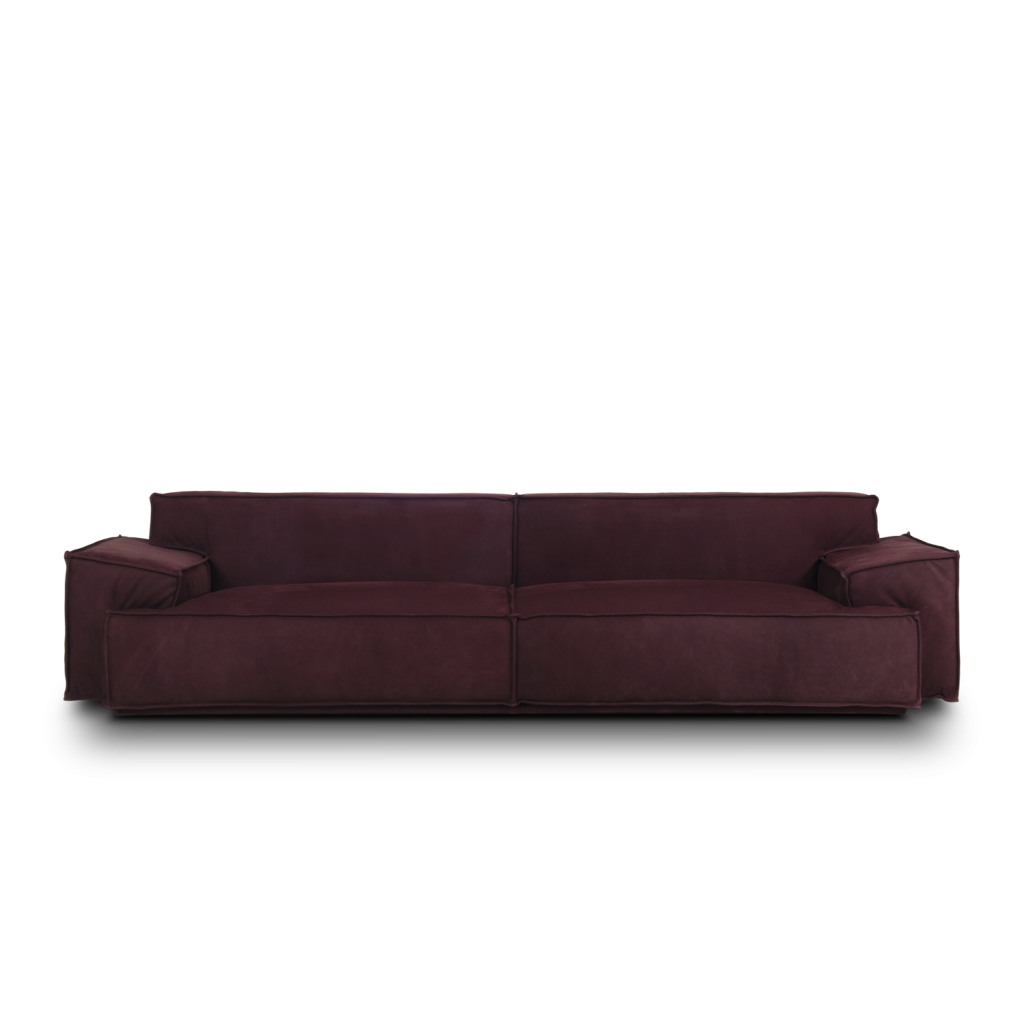
WALL

SOFA WALL

designer: Nicolás Cervio

Movement has been inscribed into the sculptural shape of the Muro sofa.
The low, floating form of this modular sofa draws inspiration from the aesthetics of the 1950s and 1970s.

The Muro modular sofa is a sculptural form built on a dialogue between architecture and interior design. The starting point was aesthetics of the 50s and 70s., which became the foundation of a timeless and fully contemporary form.

A characteristic element of the project is diagonal cutting of the edge of the backrest and the front part of the armrest at an angle of 65°. This precise detail gives the structure a sense of movement, evoking the dynamic language of mid-20th-century architecture.

The low seat line, wide armrests and plinth that raises the sofa above the floor give it stability while maintaining visual lightness.

Muro is a modular system with a clearly defined language, consistent in any configuration. Modules can be freely combined to create systems ranging from compact to extensive – suitable for both private interiors and commercial spaces.

TYPE
Modular sofa, non-extendable

COMFORT TECHNOLOGY
Elastic belts – made of natural latex, ensuring the durability and elasticity of the seat.
SoftLayers™ – a system of multi-layer flexible foams, including a thermo+ layer, ensuring high comfort of use and high resistance to deformation.
VelaFit® – advanced nobonobo comfort technology based on ultra-thin fibers, ensuring exceptional lightness, elasticity and durability as well as a unique relaxation experience.

LEGS
Oak, black

UPHOLSTERY
Fabric or leather

COUNTRY OF PRODUCTION
Poland

Technical information

Materials and finishes

14 materials

DESIGNER

Nicolas Cervio

An architect and designer, he sees furniture as a natural extension of architecture, part of the same creative journey. He values multidisciplinarity and views design as a process of constant exploration and learning.

When designing a piece of furniture, he imagines the context and everyday life it will become a part of. For nobonobo, he created the modular Muro sofa – a sculptural, low-slung piece, drawing on the aesthetics of the 1950s and 1970s, whose distinctive 65° beveled edges create a sense of movement.

DISCOVER OUR SOFAS

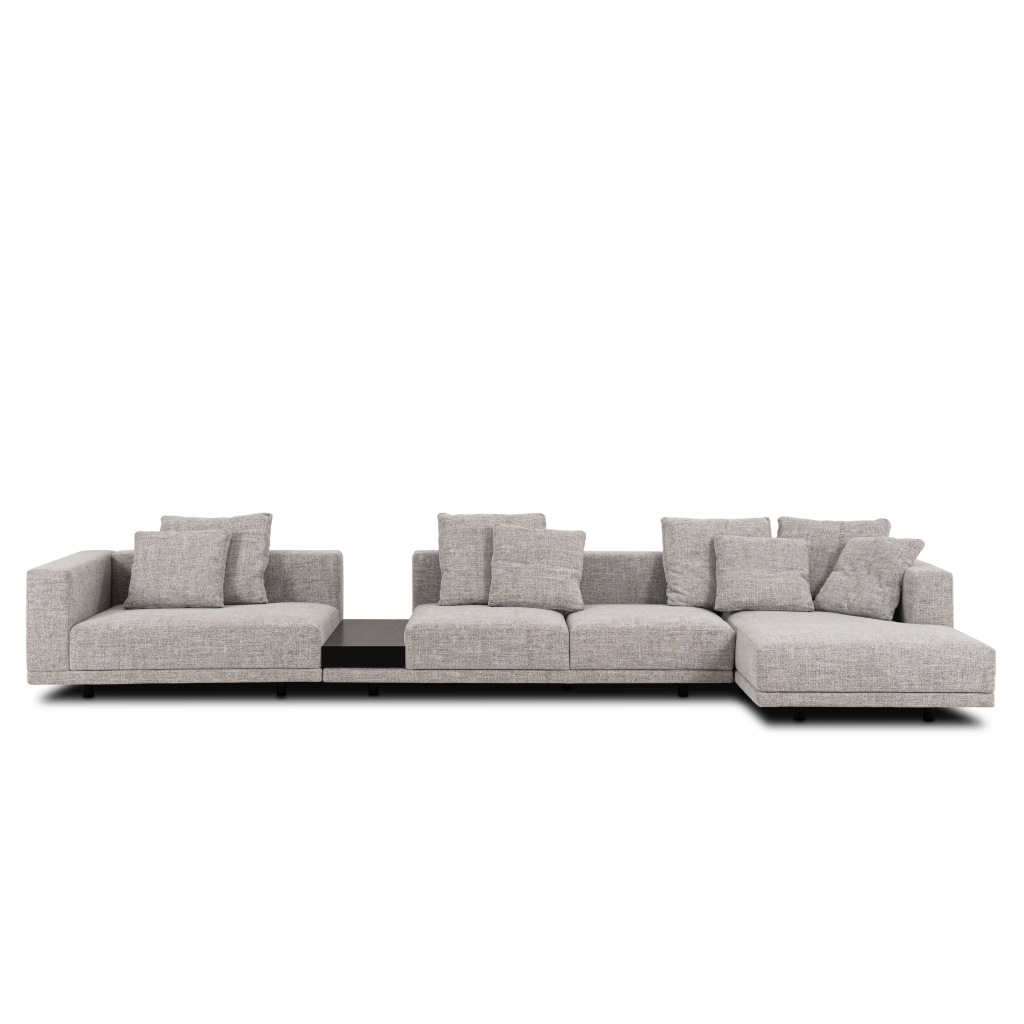
Nobonobo sofas combine contemporary design, timeless style, and exceptional comfort. The collection includes modular sofas that allow for the freedom to create individual configurations, as well as straight and extendable models. The variety of shapes and solutions allows you to tailor the sofa to the character of your interior and your individual style of relaxation.
Are you an Architect or Interior Designer?
Join the dedicated Zone For Professionals

Need individual support?

Contact our advisor who will propose appropriate solutions.

Technical information

Technical dimensions [mm]
1. Total height 670
2. Backrest height 670
3. Seat height 370
4. Armrest height 485
5. Armrest width 360
6. Total depth 1080
7. Seat depth 700
8. Leg height 25

Are you an architect or interior designer?

Register at Professionals Zone, to access 3D files, inspiring photos and more.

NICOLÁS CERVIO

An architect and designer for whom furniture is a natural extension of architecture, part of the same creative journey. He values multidisciplinarity and sees design as a process of constant exploration and learning.

When designing a piece of furniture, he imagines the context and everyday life of which it will become a part. For nobonobo, he created the Muro modular sofa – a sculptural, low-lined shape inspired by the aesthetics of the 1950s and 1970s, in which the characteristic 65° bevelled edge creates a sense of movement.

How did your journey into furniture design begin? Was there a moment that particularly influenced your decision to choose this path?

Although I'm technically an architect, I've always been drawn to designing objects, especially furniture. I believe that furniture, because of its close connection to the way we inhabit spaces, is a part of architecture. I see it as a natural extension of it.

For me, design, and furniture in particular, are part of the same creative journey. One of architecture's greatest strengths is that it allows us to transcend its own boundaries and think in a multidisciplinary manner. This broad perspective also requires continuous learning, a constant attitude of exploration, and the ability to discover new approaches to design.

muro_balmont_06 (4)

When designing furniture, do you imagine the space in which it will function, the specific type of interior, the atmosphere, the user?

When designing a piece of furniture, I envision the context in which it will function. This depends on the project's needs and the type of user it is intended for.

I like to think that a product will become part of people's daily lives and personal stories. Designing an item that will accompany these moments is incredibly important.

At the same time, it's often the user who ultimately defines the atmosphere of a product. Everyone interprets it and gives it their own unique character. I find this particularly interesting because it's the user who often reveals other ways of understanding it and integrating it into the space, thus enriching the design.

The Muro sofa designed for nobonobo has a very sculptural form, with echoes of 1950s and 1970s design. How did you translate these inspirations into contemporary design language?

References to the 1950s and 1970s became the starting point for creating a timeless and thoroughly contemporary piece. Today, it's no longer enough to simply address questions of functionality and comfort. Users have an increasingly clear sense of identity and are becoming increasingly demanding, seeking objects that also bring an emotional and intellectual dimension to everyday life.

„The 65° cut on the backrest and front of the armrest (...) of the Muro sofa (...) creates a sense of movement and inertia that defines the profile and gives the furniture a unique character.”

Was there a moment while working on Muro that particularly influenced the final character of the project?

Yes. The 65° angle cut on the backrest and front of the armrest was an important design decision in the creation of the Muro sofa. This element creates a sense of movement and inertia that defines the profile and gives the piece a unique character.

„I believe that furniture, because of its close connection with the way we inhabit spaces, is part of architecture. I see it as a natural extension of it.”

Muro is a modular system. How do you approach designing a piece of furniture that must simultaneously offer great freedom of configuration and maintain visual consistency?

When designing a modular system, I try to define a clear formal language that will remain consistent in every configuration.

What's particularly interesting about the Muro sofa is its adaptability to various scales and spatial requirements. This allows users to create arrangements that reflect their own preferences by combining modules. These compositional choices, always guided by nobonobo's professional guidance, define the final character of the piece without detracting from its distinctive expressive power.

SEARCH ENGINE

Discover nobonobo

Find your model, collection or inspiration.